Here is our latest newsletter with updates and actions.
Türkiye
Two of the 5 Gezi Prisoners of Conscience relocated: New addresses for solidarity messages
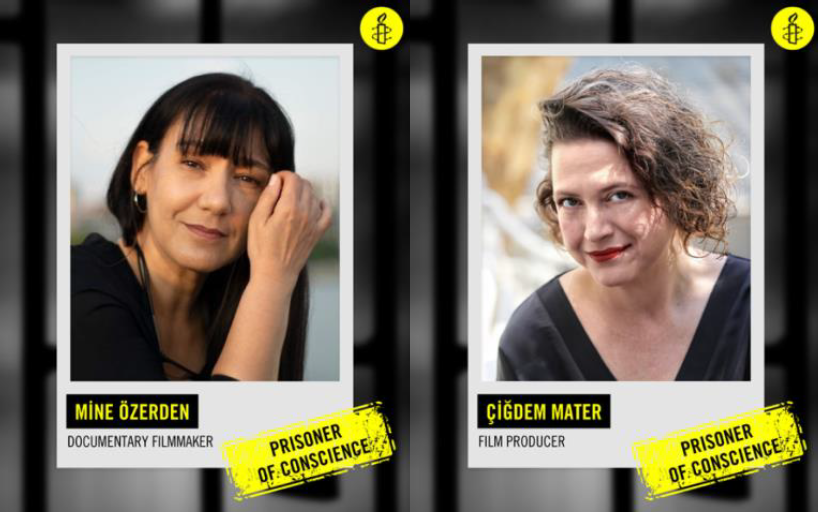 On 20 July, without prior warning, information or official justification, the Gezi PoCs Çiğdem Mater and Mine Özerden were transferred from Bakırköy Women’s prison to Izmir Şakran prison over 400km away from Istanbul. Despite their attempts, the lawyers were not informed of the reasons for this sudden transfer to a prison so far away from their families and lawyers and where conditions are reportedly very bad for prisoners generally. Çiğdem and Mine were placed in a 9sqm cell with only limited time outdoors and in very hot conditions.
Following various protests, including by Amnesty International and opposition MPs in the Turkish parliament they were transferred again back to Istanbul on Saturday 25 July but this time to Marmara prison (formerly Silivri) where the other three Gezi PoCs Osman Kavala, Can Atalay and Tayfun Karaman are also held. This is of course relief for their families and loved ones for whom the initial tranfer was a huge worry.
Çiğdem and Mine are held together and you can find their new address for solidarity letters below . They are unable to respond to all letters due to the cost but they send occasional short messages to say how much they appreciate receiving them so please renew your efforts ……or if you haven’t sent them messages so far use the summer postcard season to let them know they are not forgotten.
Marmara Kadın Kapalı Ceza İnfaz Kurumu
10 Nolu – B9
Semizkumlar Mahallesi,
Çanta Caddesi,
No:162/2, Marmara Ceza İnfaz Kurumları Kampüsü,
Silivri
İstanbul
Osman Kavala’s case with European Court of Human Rights Grand Chamber on 25 August
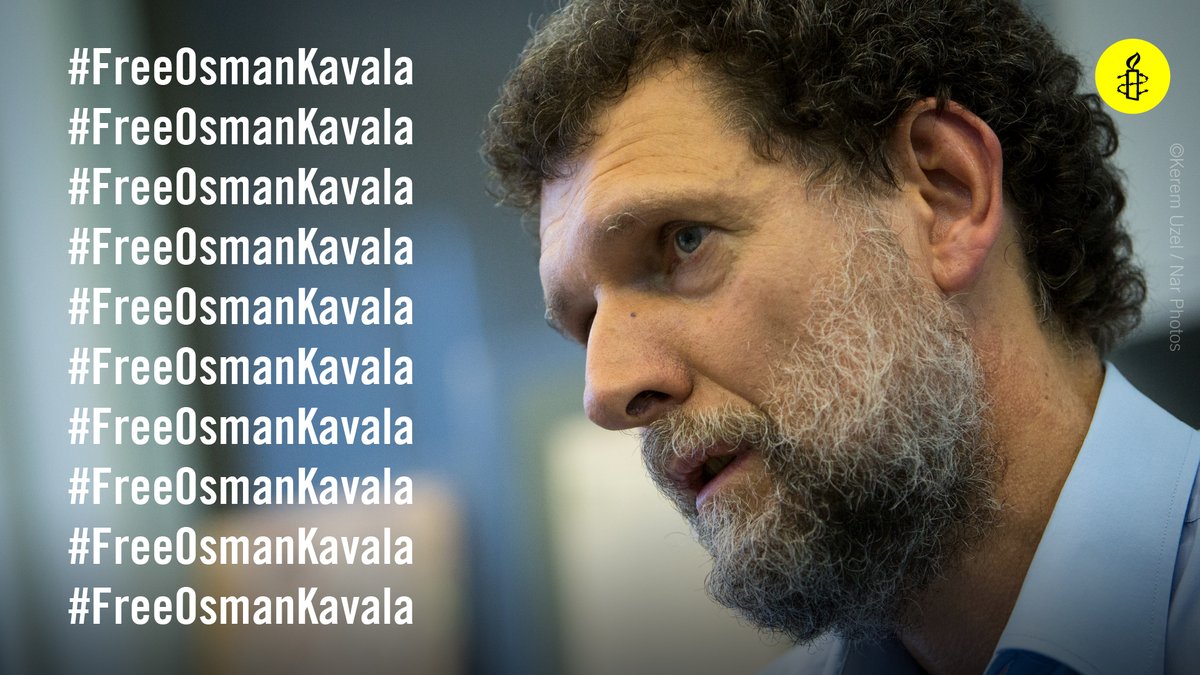 On 25 August, the Grand Chamber of the European Court of Human Rights will hand down its ruling on Osman Kavala’s application which was subject to a public hearing on 25 March this year. Together with partner organisations, Amnesty are planning a joint statement and a reaction to what we expect to the Court’s final word on his baseless prosecution and conviction for attempting to overthrow the government. The application was referred to the European Court’s Grand Chamber and therefore the judgment will be final ie not subject to a further referral.
The Court is expected to find that Osman Kavala’s fair trial rights were violated (Art 6). They may also repeat the finding of Art 18 violation, namely the prohibition of limitations on rights for purposes other than those for which they have been prescribed (prohibition of political motivation in the individual’s treatment). The consequence of such a ruling should be that Osman Kavala is released from prison immediately though, as you know, the two previous judgments remain unimplemented. ECHR Committee of Ministers have set an unusual implementation deadline of the end of August for Turkiye’s Constitutional Court where Osman Kavala’s two applications are pending since 2022 and 2023 respectively, calling on the CC to hand down its decisions by the deadline.
LGBTI activist acquitted
Rather belated news that that LGBTI+ rights defender and President of the 17 May Association, Defne Güzel, was acquitted at the first hearing of her trial on 12 May. The court agreed with the prosecutor that the “elements of the alleged crime were not present.” The case, brought in January 2026 (and the subject of an Urgent Action earlier on in the year ) alleged that material published on the Association’s website fell outside its stated objectives—despite an expert report concluding the opposite. From the outset, Defne and her supporters have maintained that the prosecution was baseless. Thankfully that position was confirmed by the court.
This is an important victory, but it must also be noted that the case should never have been brought in the first place. In the meantime, below is a message from Defne to everyone who took action in support of this outcome:
“I am grateful to each and every friend who stood by me in the struggle for LGBTI+ rights and to who supported the call for urgent action. ‘We existed, exist and will continue to exist’. None of us is alone, none of us will be defenceless. We will continue to stand with the representatives of Genc LGBTI+, with Hayriye Kaya, with Yıldız Tar, with all our friends who have exercised their right to freedom of assembly; we will continue our struggle for our rights to hormone treatment and for justice for Ahmet Yıldız.”
Thank you to all of you who took action on this case. No further action is required.
UN Human Rights Chief deplores legal changes in Türkiye that could subject children to life imprisonment
On 13 August the UN High Commissioner for Human Rights Volker Türk issued a statement deploring legislative changes recently adopted by Parliament in Türkiye that could see child offenders sentenced to lengthy jail terms, including life imprisonment. He urged the authorities to ensure full respect for Türkiye’s international obligations on children’s rights.
The amendments to the Turkish Child Protection Law, adopted on 8 August, also mandate detention of child offenders in closed juvenile institutions, with any subsequent transfer to an education-based institution subject to assessment. This breaks with the current practice of holding them directly in rehabilitative, education-based institutions.
“While some of the proposals may be positive – such as those that aim to ensure better coordination between child protection and education services and to prevent children from accessing firearms – others raise serious human rights concerns. I am particularly alarmed by the possibility that child offenders could be sentenced to life imprisonment,” said Türk.
“It is essential that the law is amended to ensure that all of its provisions are fully aligned with Türkiye’s international human rights law obligations, including on children’s rights.”
“Justice systems, including juvenile justice, should combine accountability with rehabilitation, individualized support and opportunities for reintegration,” he added.
“A focus on rehabilitation and reintegration is essential to protect victims and to reduce re-offending. It contributes to safer communities for everyone,” said Türk, warning against overfocussing on punishment and retribution.
Under international human rights law, children can only be imprisoned as a measure of last resort and for the shortest appropriate period of time. Imposition of life sentences and lengthy detention measures on children clearly runs counter to the protections enshrined in the UN Convention on the Rights of the Child.
UN Office of the High Commissioner
WE WILL NEVER WALK ALONE
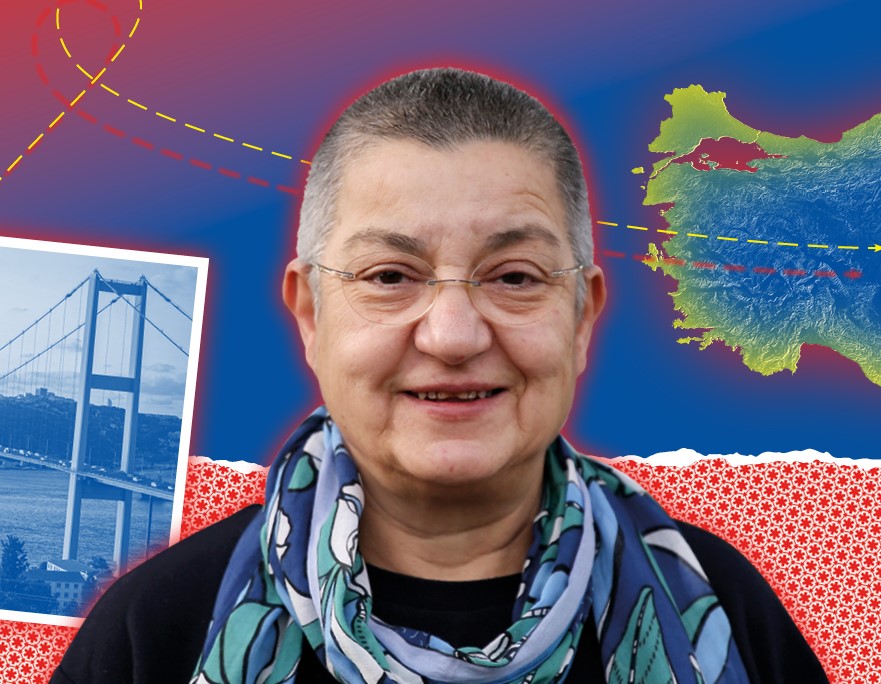
By Şebnem Korur Fincancı (Write for Rights case 2024)
Sometimes, a few lines come out of an envelope. Sometimes, a whole world.
For months, I have been opening boxes. Letters, cards, children’s still-unsteady handwriting, stickers, drawings, the trembling yet elegant scripts of those who carry the weight of years… Words that have touched me, from people aged two to ninety-two. What comes out of these boxes is not just letters. It is organized conscience. A fragment of a solidarity that includes all of us—brought together by Amnesty’s campaign. From all over the world: from India to Canada, from Japan to New Zealand. And in different languages, the same sentence repeats itself:
“You are not alone.”
Sometimes, we forget that.
When you are faced with a human rights violation, it is never only about the law. It is also about loneliness. About not knowing whether your voice will echo anywhere at all. And at that exact point, a letter written to you by someone you have never met fills that void.
Can a letter change the world? Yes, it can. But perhaps not in the way we imagine. It does not transform everything overnight. It does not change laws on its own. But it changes a person. And when a person changes, the world has already begun to shift.
Students in a technical high school in Poland wrote to me after watching a video about me their teacher showed them. Boys, with hastily torn notebook pages, stories mixed together… Girls, with carefully decorated paper, sentences woven with feeling… Each one speaking from a different place, a different awareness. Yet all arriving at the same point:
The ability to feel another person’s pain.
This is exactly what we call solidarity.
It does not have to be perfect. It does not have to be flawless. Somewhere, a child is moving a pen for someone on the other side of the world. That alone is a rupture. People across the world write to someone they have never met. Because when there is a human rights violation somewhere, it is no longer a local issue. It is a global responsibility. And that responsibility is carried not by states, as they so often fail to do—but by people, for one another.
We live in a system (culture) that constantly tells us: Mind your own life. But those boxes of letters say something else:
A person becomes human only when they act for another.
A letter may seem insignificant. But what happens when those letters come together? They create pressure. They create visibility. They force power to step back.
Silence is what human rights violations feed on the most. And these campaigns break that silence. They remind states of something simple: what they think no one sees reaches, in fact, the pen of a child on the other side of the world. An assignment given in a classroom in Lithuania is, in reality, a political act. A card sent from Canada can be as clear as a diplomatic message. Because solidarity is not just goodwill—it is a force that reshapes relations of power.
The miners’ recent victory in Turkey reminded us of something fundamental: rights are not granted from above as favours; they are won from below, through solidarity. And solidarity is not a slogan—it is a force that produces results.
And on my desk, there are still thousands of letters waiting to be opened.
I want to keep them all. Because they are not just paper. They are testimony. Solidarity. Hope. Notes humanity writes to itself.
But there is also a question in front of me:
Where am I going to put all this hope?
Perhaps the answer is this: You cannot contain it.
Because hope is not something to be stored. It grows when it is shared. And perhaps that is why a letter is never just a letter.
The letters out of the boxes, piling up on my desk keep saying this, again and again:
“You are not alone.”
And sometimes, that is the sentence a regime fears the most.
Prof Şebnem Korur Fincancı
From Evrensel (Newspaper in Türkiye)
Note : as of August 2026 her appeal against the unjust/baseless conviction is still pending at the Court of Cassation.
Updates from Southern Europe and Refugee Welcome Network
Dear Amnesty Activists and supporters
I know we are all waiting to kickstart the new Refugees Welcome Network.
I am waiting for a meeting with Mike Quinn, who is coordinating the networks as part of community organising.
As soon as I had the meeting, I will send out invitations to online meetings for all the groups and activists who are interested in building this network. To all who have already registered their interest: I have you on my list, anyone who wants to join please email me (Ulrike.schmidt@amnesty.org.uk).
There will be lots to do. Currently the new Immigration and Asylum Bill is making its way through Parliament. While the government has announced plans for new community sponsorship schemes for refugees, most of the new Immigration and Asylum Bill is tightening the screw on the most vulnerable people, making it even more difficult, or near impossible to settle in the UK , build a life and contribute to our economy and society.
The Refugee Council says the new bill could
• Force refugees to pay an unfair £10,000 charge for the support they needed after arriving in the UK, having lost almost everything.
• Put nearly 200,000 people’s lives on hold as they get stuck in a backlog of asylum appeals decisions
• Keep refugee families apart, preventing thousands of children from being reunited with their parents.
For in-depth information here are more detailed articles on the proposals.
Please write to your MP to voice your concerns.
You can use the letter formulated by the Refugee Council as a template for your own letter to your MP, or join the on-line action by the Refugee council:
https://refugee-council.movement-action.org/p/immigration-and-asylum-bill-email-to-mp?utm_source=2627EMQ215B&utm_medium=email
For further information on the Immigration and Asylum bill 2026 :
https://freemovement.org.uk/whats-in-the-immigration-and-asylum-bill-2026/
https://commonslibrary.parliament.uk/research-briefings/cbp-10940/
https://www.justice.org.uk/briefings/asylum-and-immigration-bill
Across Europe access to asylum and humanitarian protection is increasingly under threat. On 20th August Amnesty will be releasing a report about the human cost of the offshore agreement between Italy and Albania, detaining migrants and asylum seekers in in centres run by Italian authorities.
Ceuta , Spain
Tragically, at least 72 people have lost their lives whilst trying to enter Europe to seek a better future. European leaders must ensure that their response to the situation in Ceuta does not perpetrate discrimination. The unconscionable rhetoric describing the situation in Ceuta as an ‘invasion’ and reinforcing racist stereotypes must be firmly rejected.
The scenes we see are the result of Europe’s continued attempts to close and externalize its borders rather than invest in safe and regular pathways.
Please read the full briefing :
EU: European leaders must respond with humanity and solidarity to the situation in Ceuta – Amnesty International
Europe governments deport asylum-seekers from Afghanistan
And across Europe governments are starting to deport asylum-seekers from Afghanistan back into the clutches of the Taliban, often to certain death.
Please read the full article here :
https://www.amnesty.eu/news/abandon-unconscionable-efforts-to-deport-people-to-afghanistan/
Greece
Ban stun grenades in policing protests
In the July edition of the Newsletter I have introduced the mid term campaign to ban the use of stun grenades in policing protests.
Please continue to circulate the online petition over the next few months, and please let me know what actions you have taken to promote this campaign.
https://www.amnesty.org/en/petition/ban-stun-grenades-in-policing-protests-in-greece/
Find the full report here:
https://www.amnesty.org/en/documents/eur25/1012/2026/en/
For group talks and further information on this campaign please contact Ulrike.schmidt@amnesty.org.uk
FROM THE EUROPE TEAM
Don’t forget to follow us for campaigns, actions and news on social media:
https://www.facebook.com/AmnestyUKEurope
https://twitter.com/AmnestyUKEurope
https://www.instagram.com/amnestyuk_europe/
https://www.linkedin.com/company/amnesty-international-uk-europe-action/?viewAsMember=true
 and follow Lucja’s podcast “The Human Frame” through the link below https://www.buzzsprout.com/2552626
Please contact us using the addresses below for further information or to make comments on the newsletter.
Türkiye : Chris Ramsey Chris.ramsey@amnesty.org.uk
Central Europe: Lucja Jastrzebska Lucja.Jastrzebska@amnesty.org.uk
Western and Northern Europe: Jovana Bosnjak Jovana.Bosnjak@amnesty.org.uk
South East Europe: Ulrike Schmidt Ulrike.schmidt@amnesty.org.uk
United Kingdom: Elena Fowler Elena.Fowler@amnesty.org.uk